
“I’ve always had access to other worlds. We all do because we dream.” — Leonora Carrington
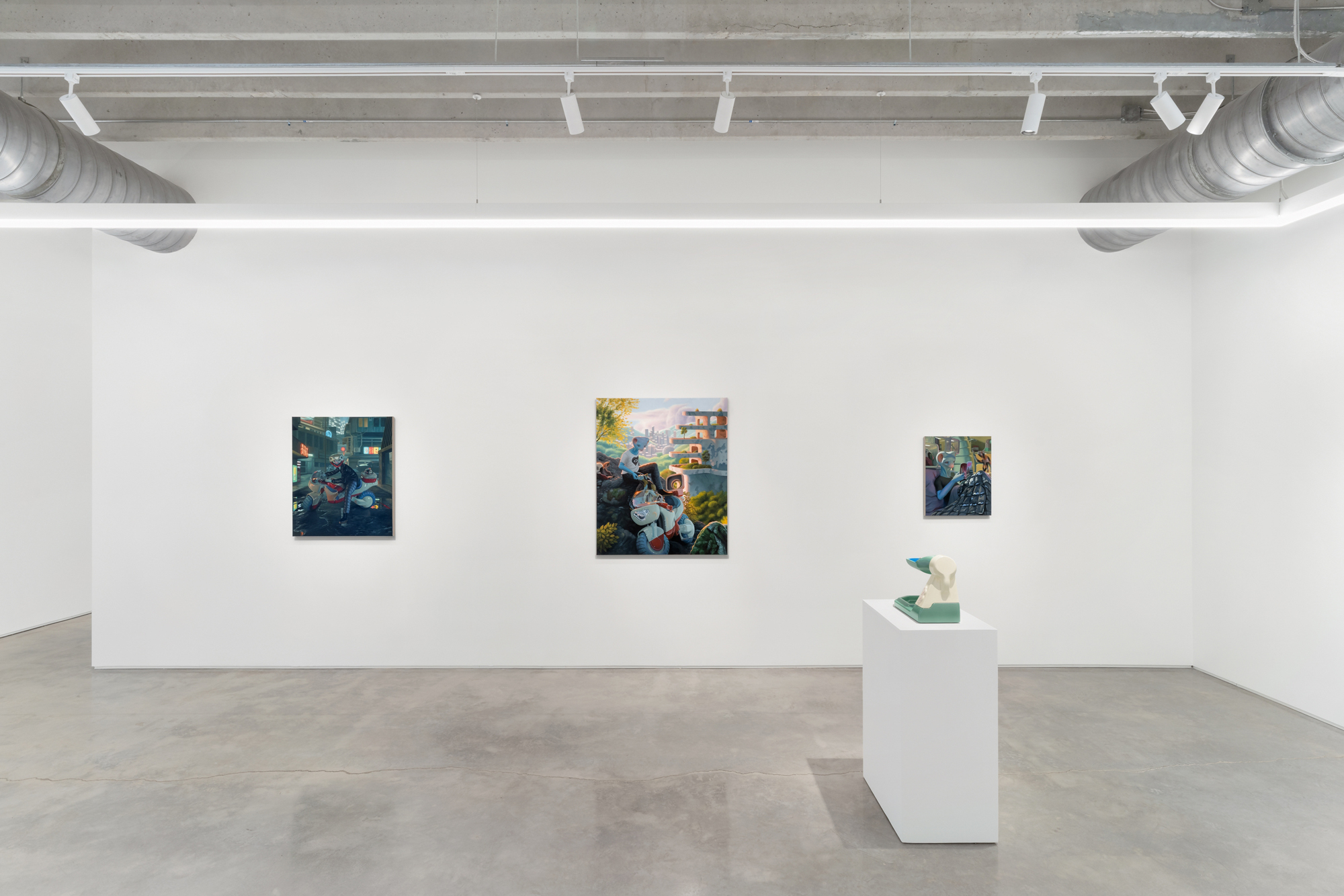
Mindy Solomon is pleased to present Jeremy Olson’s third solo exhibition at the gallery, Plague Antenna: Prologue. Continuing his exploration of the intersection between artificial intelligence and perceived reality, Olson approaches this exhibition as an extended world-building project centered on a core narrative.
“For Plague Antenna, I wanted to try something different: a longer-term world-building exercise focused around a central character, with something like an actual narrative,” Olson explains. “The narrative will be non-linear at best, prone to digressions and side quests.”
The exhibition introduces its primary figures: Meg, a youthful but harried delivery driver; her constant companion Lily, a synthetic, six-limbed feline entity with whom she communicates almost telepathically; Hector, Meg’s closest non-synthetic friend; and Lubric, Hector’s robotic, bug-headed canine companion. Small tondos depict various tools used to dispense the cartridges Meg delivers through long nights—labor driven largely by the mounting costs of maintaining Lily. The exhibition is loosely bookended by two works created in reverse chronological order: Lily’s Cradle, which presents Lily in the final stage of her gestation, and amnesia station, where an older Meg appears to work quietly at a menial job, Lily notably absent. Together, these works suggest a narrative arc shaped by attachment, loss, and transformation. Thematically, Olson explores synthetic intrusions into consciousness, mimetic desire, and the emerging risks of AI companionship. If we already struggle to determine whether our desires—or even our thoughts—are truly our own, what happens as those boundaries become increasingly porous?
Olson has long demonstrated an uncanny ability to imbue his painted figures with human-like presence. In Plague Antenna, maternal behaviors emerge through Meg’s relationship with Lily. Her labor to sustain Lily renders care both deeply affectionate and economically coercive, a tension that forms the emotional core of the exhibition. Around her, a small network of human and synthetic relationships functions as a kind of community, offering support within a rapidly shifting world.
As in previous exhibitions, Olson reveals not only his technical mastery as a painter but also his capacity to evoke complex emotional and psychological states, inviting viewers into a world that feels at once speculative and intimately familiar.
“There are no foreign lands. It is the traveler only who is foreign.” — Robert Louis Stevenson
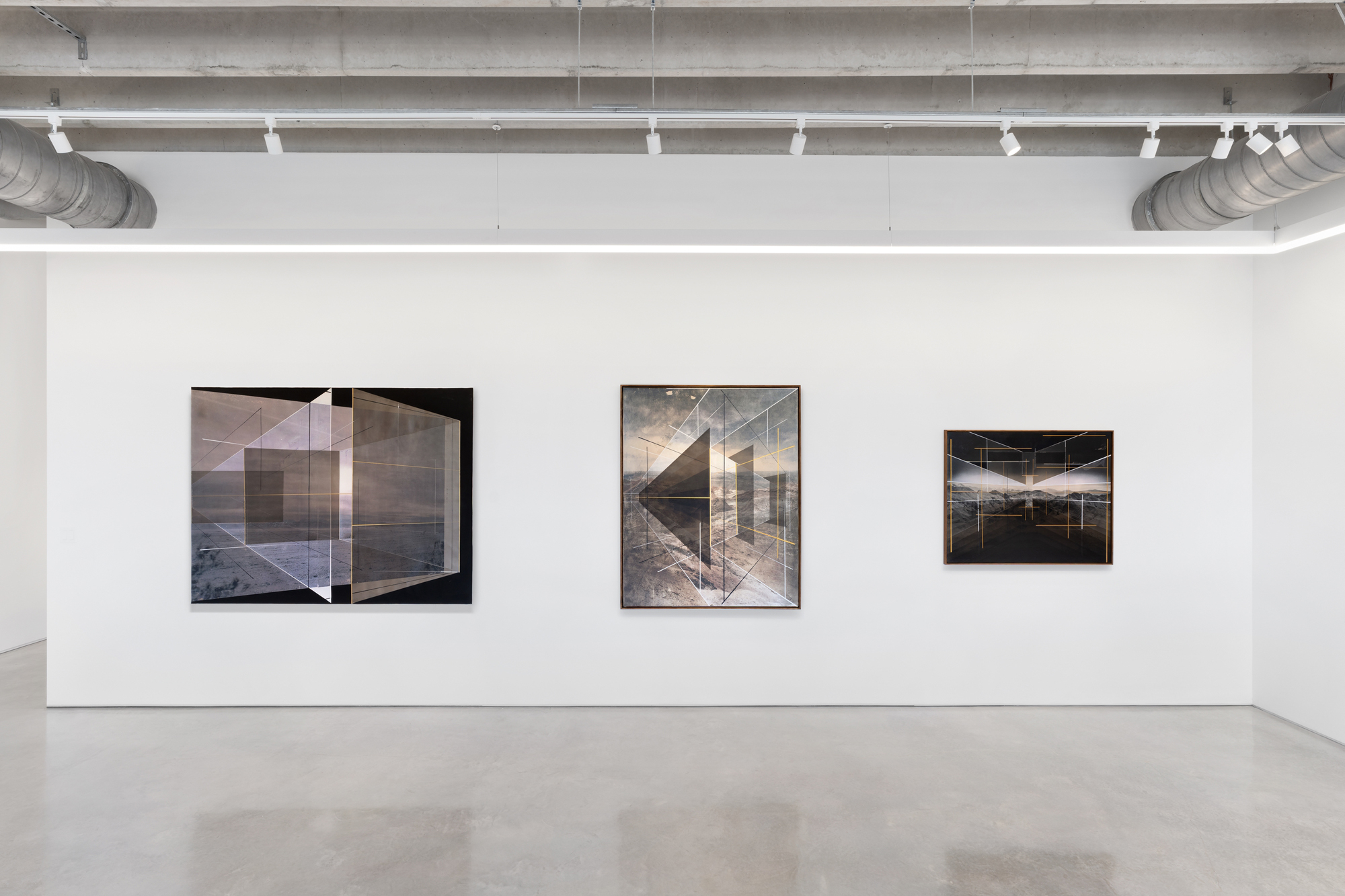
Mindy Solomon is pleased to present the second solo exhibition, Esquema, of California based Chilean artist Rodrigo Valenzuela. Focusing on altered landscapes through the medium of photography, utilizing acrylic and toner on canvas, these one-of-a-kind images invoke a sense of place and displacement simultaneously. Valenzuela writes of his work:
“For most of my 20’s, I was an undocumented worker, where I was far from family and spoke broken English. My practice is informed by that lived precarity, which never leaves you. Borrowing from science fiction and speculative research methodologies, I trace the histories of the Americas and the fraught terms of belonging within those narratives, grounding them in a contemporary context. Social commentary, philosophical inquiry, and poetics converge to examine the Latin American experience as shaped by the often invisible imperialist power. In various ways, my work prompts: What does it mean to be an intellectual of color? How might deeply personal gestures expose the matrices of society and history?
In my most recent photographic series and installations, I studied how modernist architecture in Latin America operated as a Trojan horse for CIA interventions. In other projects, the history of punk across the continent informed ceramics and prints to highlight the gestures of marginalized youth under conditions of state and social repression. In my last couple of projects, I have addressed an ever-present concern: the decline of working-class narratives in the American imagination and as a political force.”
At its core, the exhibition poses difficult questions without resolving them: Who gets to belong? Whose narratives are preserved or erased? And what happens when working-class voices fade from cultural and political visibility? Examining these landscapes, one can be drawn into their apparent vastness and momentarily forget how closely questions of belonging are tied to visibility and recognition. Yet their instability resists passive viewing. In that tension between seduction and rupture, the viewer confronts a quieter unease: that belonging is never evenly granted, but produced through histories that determine who is seen, who is displaced, and who is permitted to feel at home.
“Language is a city to the building of which every human being brought a stone.”— Ralph Waldo Emerson
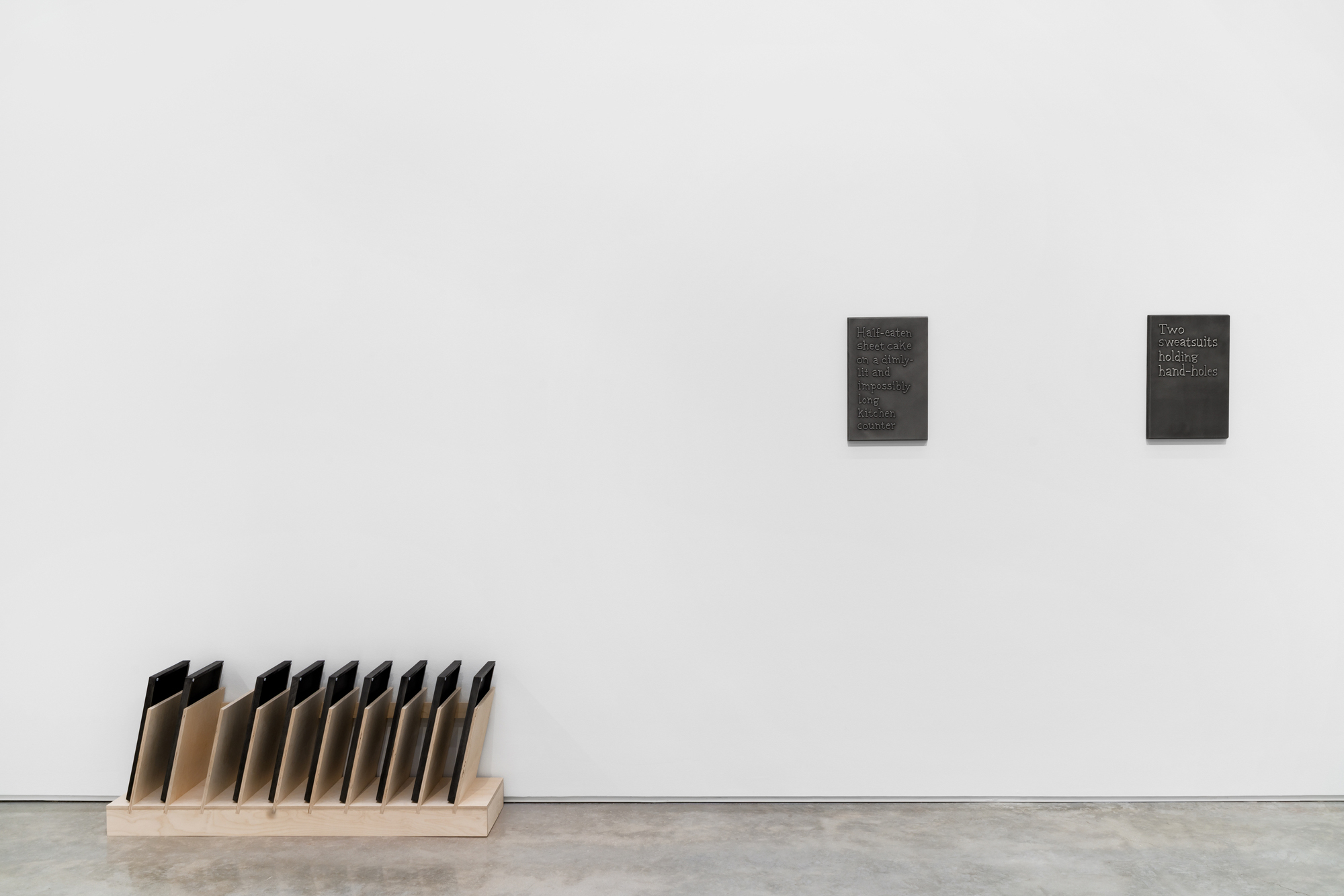
Mindy Solomon is pleased to present the second solo exhibition in Miami by artist Mathew McConnell. In Group Show (a solo show), McConnell debuts a series of text-based works derived from descriptions of artworks. In his own words:
“The sixty cast iron panels in this exhibition, produced in residence at the Kohler Arts/Industry program, each bear a short description of another artist’s work. To make them, AI was asked to describe images of selected contemporary artworks and exhibitions. The resulting phrases were then drawn by hand, and each letter digitally modeled and 3D printed as its own imperfect object, before being cast in iron through a sand-casting process.The work is the result of a series of translations, each leaving a trace in the final object. The artworks being described are not named. Each description is specific, yet its specificity is unattached; the source work comes undone in the act of being described. The text becomes fiction, fixed in iron, offering no way back to what it once referred to.In the act of reading, a new artwork takes shape — singular, specific, and attributable only to the viewer. The installation reflects this openness: a shifting selection of panels hangs in small groupings, while others rest on low racks. Works can be easily rearranged, and each configuration represents one of many possible ‘group shows,’ assembled from a larger field and subject to constant change.”
McConnell’s practice balances conceptual rigor with material precision. Each cast panel is meticulously crafted, yet the language it carries remains unstable, unmoored from origin and resistant to verification. By transforming descriptions into autonomous objects, McConnell severs them from their sources and transfers interpretive authority to the viewer. What emerges is not a reconstruction of absent artworks, but a meditation on how meaning is produced, fractured, and reassembled. The work exists less in what it once described than in what it becomes through reading — an artwork completed in the mind of the viewer.
Mindy Solomon Gallery specializes in contemporary emerging and mid-career artists and art advisory services. The gallery represents artists working in painting, sculpture, photography, and video in both narrative and non-objective styles. The gallery program explores the intersection of art and design through an ongoing dialog between two and three-dimensional objects, while embracing diasporic voices. Utilizing the gallery space as a platform for inventive exhibitions, museum visitations, and public lectures, Solomon invites a sense of community and aesthetic enrichment.
Solomon founded the gallery in 2009 in St. Petersburg, Florida, where she established her reputation as a contemporary art dealer. She is a Board member of the Miami Art Dealers Association and is currently located in the Allapattah neighborhood in Miami.